
Gripping and grasping is a fundamental aspect of grappling; and the
uncomfortable truth (for those who don’t practise the skill) is that
grappling is an instinctive element of human unarmed combat which can’t
be avoided unilaterally even if one’s penchant is for striking!
Grip fighting plays (or played until a recent rule change by the IJF in
2014) a major element of competitive judo as it does in all other
grappling disciplines. Karate’s grasping or gripping hand technique,
tsukami uke, appears clearly (ie without the need for any creative
interpretation) in numerous Shotokan katas. Perhaps the first clear
examples of grasps to control an aggressor appear in the fourth Heian
kata, Heian Yondan. In this kata grasps are used to set up the enpi
(elbow) strikes in the middle sequence of the kata as well as the hiza
geri (knee kick) towards the end. Furthermore the kakewaki uke (wedge
block disengagements) although performed in the kata with a clenched
fist, also envisage a context of close quarter grip fighting.
These techniques, but moreover the principles, can provide a basis upon
which competent hand to hand grip fighting can be developed. I would
suggest three drills where the objective in each is to practise
achieving a dominant grasp against a reasonably compliant training
partner:
1. Bicep control pummelling – start in a neutral position: grasp your
opponent’s bicep on the dominant inside line with one hand, and the
outside line with the other. Your opponent does likewise. Take turns to
achieve a dominant double inside bicep grip in a continuous drill.
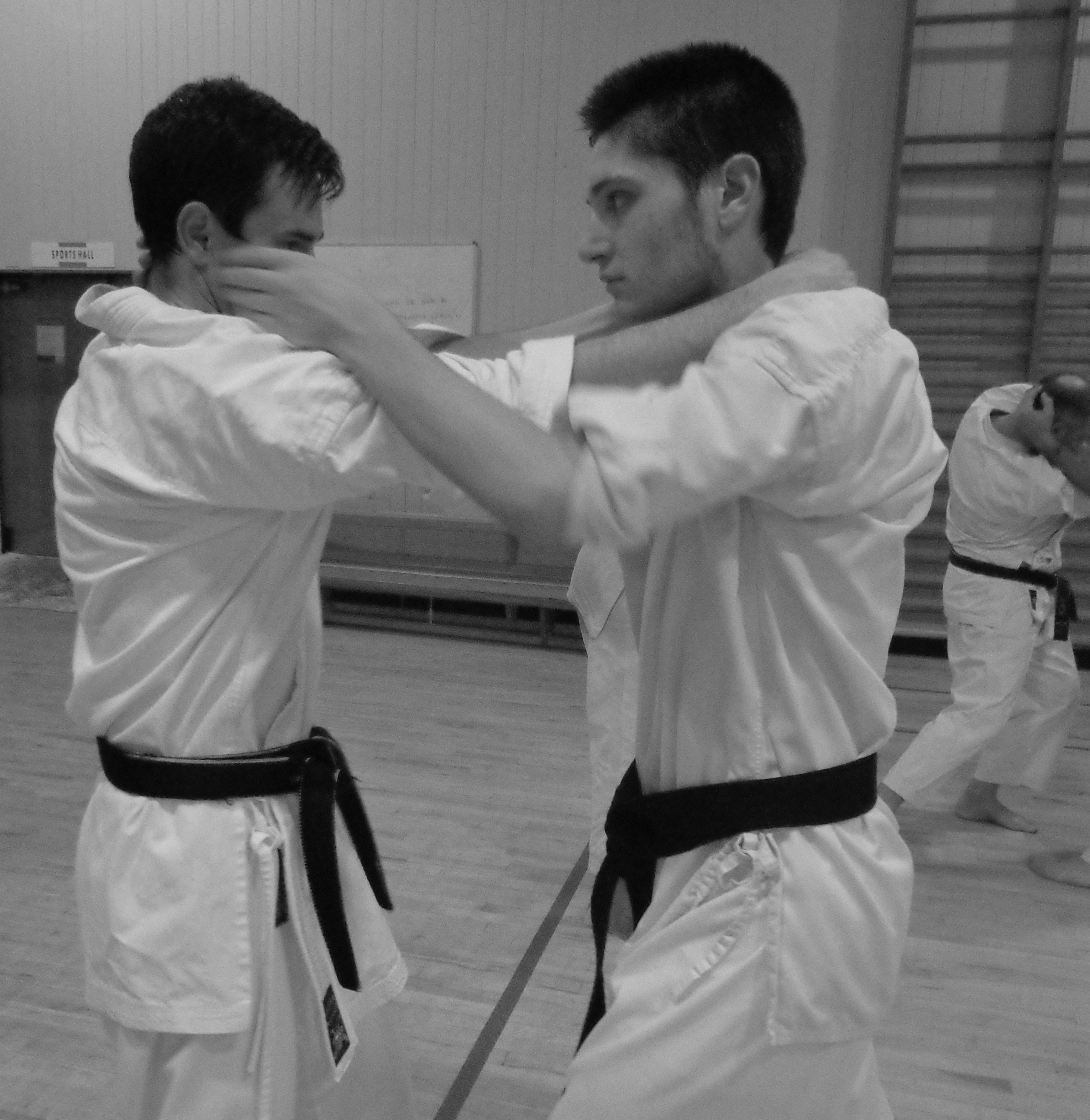
2. Neck clinch – start by grasping your opponent’s neck with both hands
cupped one on top of the other for maximum control. Allow your opponent
just enough room to ‘swim’ each of his hands inside, one by one, to
achieve a dominant inside position. Take turns in this way in a
continuous drill.
3. Body control pummelling – start in a neutral position: grasp your
opponent’s waist on the dominant inside line (under your opponent’s arm)
with one hand, and the outside line (over your opponent’s arm) with the
other. Your opponent does likewise. Simultaneously each swim the outside
arm to the inside position (frustrating your opponent’s position change)
thereby achieving a neutral position on the other side in a continuous
drill which simulates the struggle for the dominant double inside
(underneath) position.
Each drill can be taken to the next stage in a controlled competition
where the objective is to achieve the particular dominant position
against a non-compliant opponent doing likewise. The next step of course
is to engage in a competitive hand fight where the techniques and
principles are practised at an instinctive level below conscious thought
(as opposed to a choreographed exchange) with the challenge of achieving
control of the opponent’s head or body with a view, of course, to
setting up a finish by way of strike or take-down or both!
Oss!

 SOUTH NOTTS KARATE